
Adapted from Words Like That S2 Ep. 5, originally released July 12, 2024.
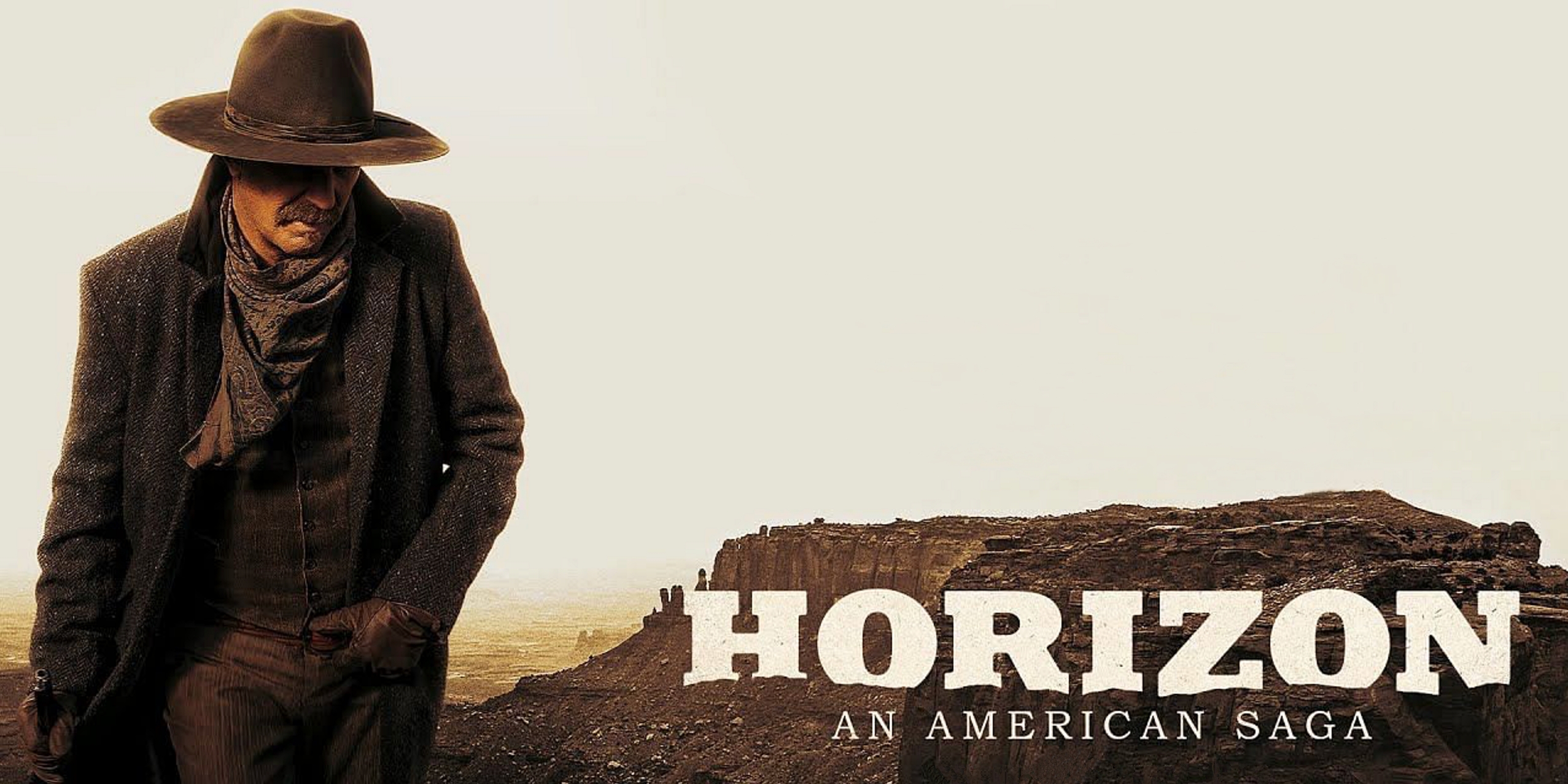
Horizon: An American Saga, Pt. 1. is the 3-hr.-long first installment in actor/writer/director Kevin Costner’s ambitious cinematic experiment: a western tetraloogy examining American expansion in the second half of the 19th century. The first two entries were filmed back-to-back, with Pt. 1 releasing June 28 and Pt. 2 originally set to release six weeks later on August 16. Meanwhile, Pt. 3 is currently in production. Costner has also financed a hefty chunk of the production himself, with a personal investment of $38 million confirmed.
Unfortunately for Costner, the first film has received decidedly mixed critical reviews and has performed abysmally at the box office. In its opening weekend, the movie squeaked into the #3 domestic spot with $11 million and fell from the top 5 earners with under $6 million in week 2. Following its week 2 slide, Costner's production company, Territory Pictures, announced Part 2 would be pulled from its intended August release date, with a new date TBD, while Part 1 would become available on VOD July 16 while still in theaters. The latter film's poor performance is also unfortunate for the entertainment industry at large, because, despite a cold reception, Part 1 is quite good and reminiscent of a number of excellent long-form narrative works, including:
‘80s television miniseries Lonesome Dove, but produced with a massive budget and designed specifically for the big screen;
John Ford westerns, with their sweeping vistas and complex portrayals of tribe and settler dynamics in the Old West;
Epic dramas of early cinema, such as Gone with the Wind and Giant, which featured expansive casts and focussed on human relationships;
Peter Jackson’s Fellowship of the Ring adaptation, which teed up an epic ensemble piece while ended abruptly with no resolution;
Classic novels, like War and Peace and Moby Dick, that hailed from a time when reading reigned supreme as the most accessible form of entertainment, and audiences reveled in escaping into massive narratives that eschewed tight plotting in favor greater world immersion and character intimacy.
While Horizon, Pt. 1 may not be quite as magnificent as any of the above works, the elements it shares with those storytelling heavyweights makes for a compelling 3 hours at the cinema.
First, Costner’s direction is masterful, and his collaboration with cinematographer J. Michael Muro produces some of the most gorgeous landscape shots of this century. But the vistas alone count for little without relatable characters and engaging narratives, and the film is chock full of both.
Two primary plot threads propel the movie’s first 2 hours, with a third plot added in hour 3. Although the plots and subplots may seem disjointed, they’re clearly connected by the drive west toward the titular settlement, with the implications being that all threads will eventually intersect. But even if the stories end up being only tangentially related, western fans should find the disparate sets of archetypical genre characters and situations interesting enough to warrant their investment of time.
Costner pulls out nearly every old west trope in the book—settlers vs. Indians, cavalry to the rescue, a stoic horse trader on the run from a gang, wagon train west, etc. Even so, he keeps the characterizations more realistic, more human, than most westerns of Hollywood’s golden age, but without resorting to the revisionist cynicism that overtook the genre in the ‘60s. In Costner’s west, there are really good guys, who strive toward virtue, and really bad guys, who only work iniquity. But there are also those characters between—those who live by a more ambiguous code, or who perhaps don’t quite live up to the virtuous one they strive for.
It’s a realistic portrait of human morality brought to life by a (mostly) stellar main cast that includes Costner, Sienna Miller, Sam Worthington, and Jenna Malone. Veteran character actor Michael Rooker serves as a highlight of the sprawling ensemble with his portrayal of army Sgt. Riordan, a character clearly inspired by Victor McLlaglen’s roles in Ford’s cavalry pictures (although, for some reason, Riordan’s Irish accent doesn’t seem to materialize until the end of his first sequence in the film).
Perhaps the most shocking turn comes from Luke Wilson as the wagon train master from plot three. Not that I thought Wilson was a bad actor before this film; I’ve simply never envisioned him as a cowboy, a role he perfectly embodies here. He’s strikingly reminiscent, both in look and delivery, of Rawhide’s Sheb Wooley (perhaps better known as the singer/songwriter behind “Purple People Eater” and the presumed actor behind the famous “Wilhelm scream”).
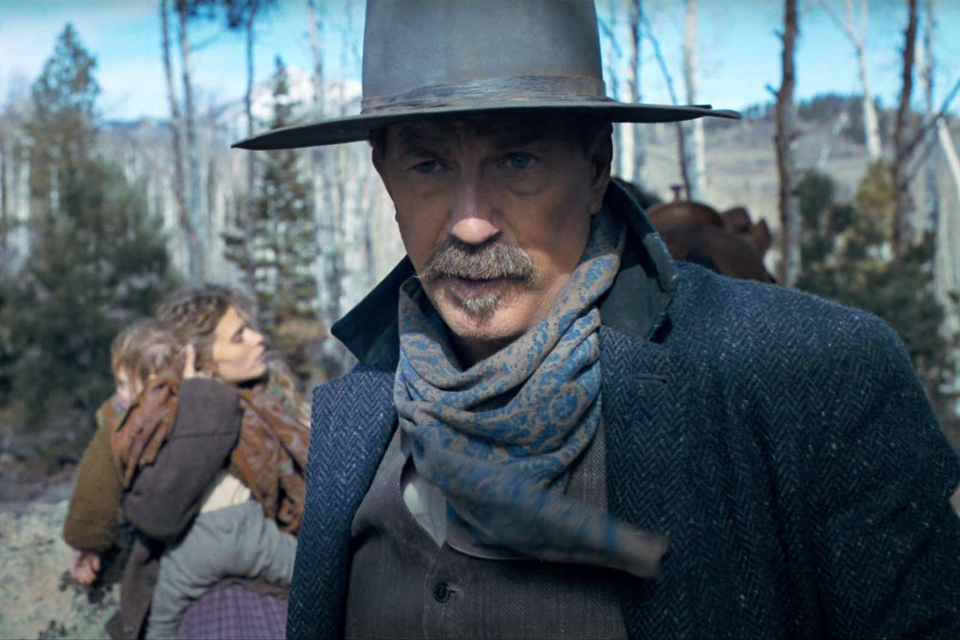
While much of the supporting cast doesn’t quite reach the level of the major players, the single biggest casting misstep comes in the form of the Sykes brothers, the lead villains in the plot thread involving Costner’s character. It’s clear actors Jamie Campbell Bower and Jon Beavers are shooting for the mesmerizing sociopathy of modern cinematic antagonists such as Heath Ledger’s Joker and Javier Bardem’s Anton Chigurh. But the Sykeses come off more cartoonishly over the top than gleefully menacing, although, in fairness to the actors, scenes and conversations that run too long, only magnify the movie’s flaws.
In fact, excising just a bit of footage from every major action sequence and important conversation could’ve cut the film’s runtime by 30 min., reducing the impact of Horizon’s imperfections without lessening the scope or nuance for which Costner is striving. The dialogue also suffers from a bit of heavy-handiness—telling and not showing—and an occasional corny clunker.
Another issue lies in the visibility of the film’s low-light sequences. Perhaps this was a quirk of the small theater in which I watched the film, but dark sequences, particularly action-oriented night scenes, were difficult to see and, thus, intermittently confusing. Some scenes also needed better visual or audio cues to inform the audience of time and space jumps (an issue Horizon shares with another 2024 epic, Dune, Pt. 2).
Still, the film’s transgressions aren’t harmful enough to seriously damage the picture. So, why is it struggling to find its footing?
Some have proposed that the western is a dead genre that simply can’t muster enough interest to mount a decent showing at the box office. Yet somehow Yellowstone, another Costner-led western (yes, a neo-western, but a western nonetheless), has been a smash hit for Paramount. So, clearly, the western market, and specifically, the Costner western market, still exists. Therefore, we must look toward another explanation behind Horizon’s poor showing.
One consistent complaint among both critics and audiences lies with the film’s length and pacing. While I agree the film could’ve used a bit of trimming, a long runtime and slower pacing can be creatively justified when the primary purpose of a picture is to immerse the audience in world, character, and story. Consequently, Horizon’s start-to-finish snail’s pace is more forgivable than the slow opening act of a film like Kingdom of Planet of the Planet of the Apes, a sci-fi actioner that’s four films deep in its world-building and ten deep in its franchise.
But in our social media- and electronic device-driven world of instant gratification, attention spans have declined to the point where sitting still for 3 hours to watch a story slow burn to fruition seems an impossible task.
But how, then, do some many people spend hours binge watching the latest streaming series?
Well, first, episodes of even the most serialized shows are fast- or at least moderately-paced within themselves and possess some measure of independent digestibility. In addition, home streaming affords viewers the ability to watch on their on time, in attire of their choice, with beverage and food of choice, plus the ability to pause or stop playback at any time for any reason—all options that no respectable theater can allow. I think this last point might be the culprit behind low audience attendance, if not most attendee complaints.
When it comes to critical reception, however, I think Costner’s eschewing modern subversive and deconstructionist sensibilities for traditional, old-fashioned storytelling might disincline professional critics to give a pass to Horizon’s lumbering speed and extraordinary length the way they did with Oppenheimer, a narratively incoherent slog of a film, devoid of sympathetic characters. (I know; I’m in the minority on my disdain for Nolan’s latest box office juggernaut.)
Regardless, Horizon’s structure lends itself so much to modern television sensibilities that perhaps it can find its audience on streaming, justifying its production cost and allowing Costner to complete his vision. If so, and if Costner can deliver on the promise of Pt. 1, An American Saga may go down as one of the great entries in western canon. If not, it will be shame for cinema and a massive disappointment for fans of this first installment, myself included.
I rate it an 8/10, and if Pt. 2 were released tomorrow, I’d already have my ticket in hand.
What do you think? Have you seen Horizon, Pt. 1? If so, did you like it? Did you hate it? If not, what has kept you from going to the theaters? Will you check it out on streaming? Let us know in the comments or send us an email to randominerecords @ yahoo.com (no spaces).
Cole Powell is an arts and media commentator and award-winning singer/songwriter from Jayess, Mississippi, USA. Powell holds degrees in computer technology and liberal arts and sciences and wants to be a comic book artist when he grows up and learns to draw.