
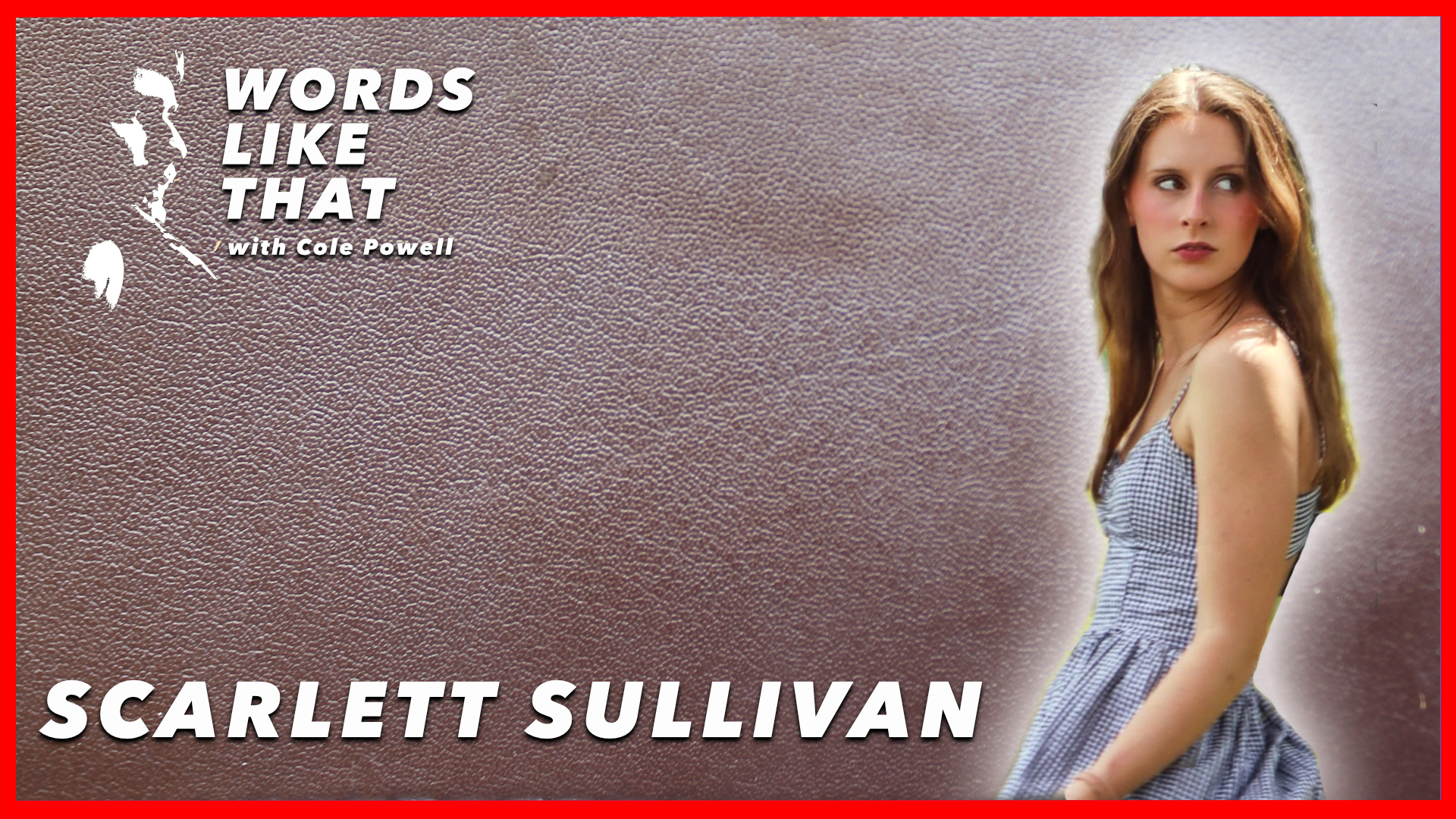
“Scarlett Sullivan is an indie-pop artist whose music reflects the honesty and emotions of teenage life. Raised in Mississippi, she draws inspiration from her hometown and personal experiences, capturing moments of growing up, self-discovery, and life as a young artist. She has built momentum as a live musician, regularly gigging and connecting with audiences through her performances.
Scarlett received industry recognition with a nomination for Best International Solo Act at the 2026 Annual Radio Wigwam Music Awards, and her song “The Man” has amassed over 200,000 streams, marking a key milestone in her emerging career. She records music with the immensely talented Chad Wesley and Nathan Maines at Eternal Beyond Studio in Richland, Mississippi. With a focus on authenticity and storytelling, Scarlett Sullivan continues to shape an indie-pop sound rooted in real-life experiences.” — ScarlettSullivan.com
The following interview is adapted from Words Like That with Cole Powell, S4, E3, and has been edited for length and clarity.
COLE POWELL: Scarlett, welcome to the show.
SCARLETT SULLIVAN: Thank you so much. I’m glad to be here.
COLE: Great to have you. This is the first time I’m meeting you in person, but I’ve known your dad for a number of years. Dad is in the audience today with us. And I feel like I’ve gotten to know you quite a bit because he introduced me to your music pretty early in your career — really before you had a career.
And I’ve got to tell you, I was blown away by some of the stuff he showed me when you were, I think, 12 or something like that.
So let’s talk about this Radio Wigwam Award. This was in England?
SCARLETT: Yes.
COLE: Tell us about that.
SCARLETT: It was the first time I went to Europe and also my first award show, so two new experiences right there. We stayed at the Bedford, and everything was there. We got to see live solo performances from different artists they had there during the nighttime.
We also got to experience a lot of their popular music over there in London. They call it house music, so it’s kind of like EDM-type music.
Outside of the music scene, there were so many cool places to eat and places to shop. It was just like stepping into a whole other world. It was a city, which I’m not used to, for one.
Then, coming around to the actual award show on the last night, I got to meet so many new artists and so many upcoming artists. They had a lot of people from the industry there to talk to us about marketing and their musical journeys and how they’re making it through the music world.
I got to be on a podcast there as well, which was pretty cool. I was interviewed. It was just a whole fun, new experience, and I really appreciate that I was able to be second runner-up for Best International Solo Artist.
COLE: One thing that wasn’t in your bio is that you’re 17 years old.
SCARLETT: Yes, sir.
COLE: There was some language in there talking about how you’re young and how you write about the experiences of teenage life, but you’re 17 years old. So all the stuff we just talked about and that I read in your bio — and this experience you had — you’ve done all this before you’ve turned 18 years old.
SCARLETT: Yes, sir.
COLE: That is insane. That is so impressive.
I’ve known a lot of singer-songwriters in my life. I don’t even think I’ve known anybody who, in 20-, 30-, or 40-year careers, have been able to go to an awards show in Europe. So that just blows my mind. Congratulations on that. That’s so impressive.
You’ve also got two Josie Music Award nominations, right? For those who don’t know, the Josie Music Awards are a pretty big deal in the indie music industry in America — and internationally, because there are international artists who come to this. It’s held in Nashville every year at the Grand Ole Opry.
You’ve got two nominations. One is a Songwriting Achievement Award, I believe?
SCARLETT: Yes, sir.
COLE: And then the other is Vocalist of the Year?
SCARLETT: Yes.
COLE: Are you excited about that?
SCARLETT: I’m super excited. When I was younger, when I first met one of my producers, Chad Wesley, he had mentioned the Josie Music Awards. He’s won one or two of them.
I grew up hearing about them, but I really didn’t know what they were until I’d been nominated. I didn’t realize how big it was. Just seeing the immense amount of recognition and what an honor it is to be recognized for your music by the Josie Awards is really amazing.
Then there’s also the experience of being able to go to Nashville and go to the Grand Ole Opry, where people like Dolly Parton and some really famous people have performed. Just getting to be on that stage or in the same room is amazing.
COLE: We were talking a little bit before we started the cameras rolling. Y’all are planning on going up to Nashville. Are you prepared for the experience of going into the Grand Ole Opry?
SCARLETT: I think I am, but I don’t know what to expect. So I’m not sure if I can be fully prepared without knowing what I have to prepare for.
I think I’m ready, but until I get there, I’m not really going to know. I’m really excited.
And my sister got nominated for a Songwriting Achievement Award, so she’ll be with me.
COLE: Excellent. That’s great, because I was going to ask you about your sister, Ashlyn Sullivan, also a singer-songwriter — a really good, incredible singer-songwriter. So she’s also nominated?
SCARLETT: Yes, she is. A little bit about Ashlyn…
She started songwriting a little bit after me. When she was about 12 or 13, she started coming up there, too, and recording. So we’ve been doing music together and separately. Sometimes we have things we do together. We’ll write songs together.
It’s been interesting watching her grow. I got nominated for one of my big awards in London, and now being able to get nominated for another big award but do it with my sister is a really cool experience. I’m just really excited that I get to do it with her.
COLE: So she’s also going up?
SCARLETT: She’s going up.
COLE: Excellent. That’s fantastic.
SCARLETT: We’re missing our school’s homecoming dance.
COLE: When something like that comes up, are you sad you’re missing the school’s homecoming dance, or are you more like, “Ah, you can have it. I’ve got this music award thing to go to”?
SCARLETT: It’s bittersweet. It really is. I mean, I’ve been to three. I’m a senior in high school, so I’ve been to three homecoming dances already.
They’re not the most exciting because, you know, it’s just kind of a bunch of kids in a cafeteria. But I will be sad that I don’t get to do my last one with my friends. But we have prom, so I’ll hopefully go to that.
I’m just super excited about Nashville, so it’s kind of hard to be upset about missing homecoming when you get to go to Nashville for a music award.
COLE: You’re a musician going to music city, so…
SCARLETT: I mean, it’s the kind of thing everyone dreams of.
COLE: What kind of collaboration have you and Ashlyn done?
SCARLETT: We haven’t collaborated on any songs we’ve released together, but sometimes, if I write a song that I don’t think fits my voice or my general style, I’ll give it to her.
She recorded and released “Black and Blue,” which was one I had written. She’s currently recording — and she might release — another one of my songs called “The Muse.”
Then one of her songs that she has written, called “Without You,” I’m hopefully going to get to record soon. I got to practice it a little bit, but once I get ready, I’ll record and release that.
Sometimes we’ll be sitting there at night and she’ll be like, “Oh man, I have this line. Can you help me finish it?” And I’ll be like, “Girl, I got you. Let’s work this out.”
So sometimes we do a little bit of a songwriting exchange.
COLE: Do you think maybe at some point y’all will collaborate on something and release something as a duo?
SCARLETT: Definitely. I forgot to mention that she does a lot of the harmonies on my songs. She has a really good talent for harmonization. Without seeing any music or anything, she just hears it. That’s something I’m not as good at. I’m working on it.
A lot of times I’ll be like, “Hey, Ashlyn, can you help me with the harmony part?” or “Can you record and sing this harmony part for me?” So that’s another way she’s collaborated.
In terms of releasing a song together, I definitely think that’s something we’d be interested in, and I hope we can do that in the future. We’ll definitely see.
COLE: That’s got to be great, too, to have somebody in your household who has the same interests and the same type of talents, but also a different skill set. Like you mentioned with the harmony — you haven’t quite developed that yet, but she has a natural gift. And y’all can work together in the songwriting process. I don’t think there are a lot of people who have that.
SCARLETT: Yes, it’s nice.
COLE: Yeah, it’s got to be. That’s a huge blessing for the field you’re working in — to have somebody like that right there in your house who can do that and help you with it.
So you said you’re a high school senior. You do show choir?
SCARLETT: Yes, sir, I do.
COLE: And you’re also in an a cappella group. Tell us about those two things.
SCARLETT: This year, I kind of overloaded myself with lots of choirs and stuff because it’s my last year and I don’t have to take a ton of academic classes. So I thought, might as well do something fun, right?
I’m doing the Reveille Show Choir, which is our mixed show choir. It’s about 55 singer-dancers. It’s about a two-to-one ratio of girls to boys, so we have a lot more girls than guys. Our theme is Sherlock Holmes, so it’s a mystery-type show.
Then, for our Renown, it’s about 44 singer-dancers. It’s an all-girls show choir, and we’re doing The Queen’s Gambit. It’s the show about this girl who becomes a chess prodigy. I haven’t seen it, so I don’t know a whole lot about it, but I do enjoy dancing the show.
Then for the a cappella group, that’s our Madrigals. We’re Madrigals in the fall, and then in the spring, we’re Renaissance. In the fall, we dress up in Renaissance attire, and we do Christmas dinner and sing traditional a cappella pieces.
Then in the spring, we do an a cappella showcase where we sing pop songs and compete at competitions. We have a “Rain” theme this year.
COLE: Nice, nice. I’ve got a huge a cappella fan audience. That’s kind of how I built my YouTube channel, reacting to a cappella groups. Their fan base loves everything a cappella.
I love a cappella.
SCARLETT: It’s talent.
COLE: I don’t think I could make it in a cappella. I think my voice has to have some instrumentation behind it. I don’t think I could do the a cappella thing.
Although I have thought about maybe trying some, I just admire somebody who’s able to get in there and sing with an a cappella group and do it well.
So was this your first year with the a cappella group, too?
SCARLETT: The pop a cappella group is fairly new. But as far as Madrigals goes, I did it in 10th grade. I took a break in 11th grade, and I’m coming back in 12th grade to do it.
They started the pop a cappella in my 11th-grade year. I’ve been watching Pitch Perfect since I was little, so I was like, “Man, that sounds fun.” This year, I was like, “I’ve got to try that at least one year. I’ve got to have that experience.”
I’m super excited.
COLE: So let’s get into your creative journey.
You released your first song, “Obvious” — that’s the title of it.
SCARLETT: Yes.
COLE: When you were 14. This was back in 2022, I think?
SCARLETT: Yes.
COLE: Before that, you started playing guitar and singing when you were like 10 or 11?
SCARLETT: Ten or 11.
COLE: Obviously, before you got to that point where you picked up a guitar, started singing, and started writing, you had some kind of musical influence drawing you to that. So let’s talk about that. What were your musical influences?
SCARLETT: There were a number of musical influences I had. Taylor Swift was one of the big ones. She’d come on the radio, and I’d just start singing.
COLE: I was going to mention the Taylor Swift comparison because I hear a lot of influence in there.
SCARLETT: Yeah. But unfortunately for me, when I was younger, I was kind of tone-deaf. So it’s been a long journey. I was a little tone-deaf, I can’t lie.
Going back and listening, I was like, “Oh, man.”
But my dad really encouraged me to start learning guitar, which really helped with my pitch accuracy and things like that. With hard work and determination, I was able to start playing guitar.
Then one day I was bored at home, and I was like, “Man, I want to write a song.” I wanted to be like Taylor Swift. I thought it was really cool that she could do that. So I was like, “Let me give that a try.”
I wrote my first song. I don’t remember what it was called, but it was something about there being a mess but it still being beautiful. It’s lost to the winds of time.
COLE: I think I may have heard this song from your dad when he was showing me how talented his daughter was. Was it something like “Classy…Trashy”?
SCARLETT: I remember that one! That was one that came a little later.
COLE: Okay.
SCARLETT: I don’t know that one will ever see the light of day.
COLE: I dug it! I remember I was blown away. Obviously, it stuck with me because this was like six years ago or something. I was like, “Man, this is fantastic.” Think about it. Think about releasing that.
SCARLETT: One day it could happen.
And then, just having these musical influences, my dad really being in my corner and encouraging me, and encouragement from my teacher, Chad Wesley — he was a really instrumental part of my music career.
He finally pushed me to write my first real, completed song, “Iron Shield.” And then I eventually recorded my first studio song, “Obvious.”
COLE: I’m glad you mentioned “Iron Shield” because that was my next thing I wanted to get into.
I want to actually listen to some of these tracks. We’ve got them queued up, and we’re going to play some clips here.
In your bio, it says you’re an indie-pop artist, and I hear that pop thread that runs through all of your music. The last guest I had on the show, Sam Mooney, I said the same thing to him. I hear that pop thread running through his music, too.
But you’re really a multi-genre artist. Particularly those first few singles you released, it was like, one after another, each single was a different genre.
So let’s take a look at “Obvious.” Presley, let’s play a clip.
This is your first song. How old were you when you wrote “Obvious”?
SCARLETT: Maybe 12 or 13.
COLE: Okay. And you released it when you were 14?
SCARLETT: Yeah.
COLE: Okay. Presley, let’s hear a clip of that.
[CLIP PLAYS]
Yeah. Okay. So that is just straight-up punk rock.
SCARLETT: Yeah. Punk rock. All the things.
COLE: One of the things I hear in your songs — I don’t know if these are part of your influences or not — but I hear a lot of 2000s music. Did you listen to some 2000s rock and stuff growing up?
SCARLETT: Let’s see. I’m trying to think, because over the years, my music style has changed drastically. But I still listen to a little bit of Fall Out Boy and things like that. And a lot of One Direction. I know that’s not punk.
COLE: Yeah, and that’s more in the 2010s.
SCARLETT:I just listen to a whole range of artists. My mom listens to a lot of ’90s hip-hop. My dad listens to old country. Then obviously I’ve got mainstream pop, and my grandma plays Christian music. So I’ve had a lot of influences over the years.
COLE: Like a buffet.
SCARLETT: Yeah. I kind of get to experience everything, which is really great.
It’s been a big journey of self-discovery, trying to figure out where I think I fit best. I think I’m starting to find that.
But it’s been really fun getting to go from, “Okay, we’re going to do punk-pop,” and then, “We’re going to do a ballad, like a rock ballad.” And now a Christian song, a country song, and more of a mainstream pop song. So it’s been really fun getting to explore everything.
COLE: That was actually what I was going to say.
You’ve done something that I don’t think a lot of people do. You took that song, which was your first song released four years ago, and you released a new version, “Obvious Reimagined.”
That was this year, right?
SCARLETT: Yeah. Early this year?
COLE: So let’s play a clip of that. We already played the first version. Let’s do the second version.
[CLIP PLAYS]
Okay. So, version one. Straight-up Avril Lavigne, angsty.
And this one is so different.
I feel like with this and most of your recent tracks, you can really hear that early Taylor Swift influence. That’s what this reminds me of.
SCARLETT: Me and my guitar. That’s how it starts.
COLE: There you go. One hundred percent.
So, I don’t think — do you know who Eric Clapton is?
SCARLETT: No, I’m not familiar. You might have to remind me.
COLE: Okay. You need to educate your daughter. I’m blaming you for her not knowing Eric Clapton.
Eric Clapton is one of the greatest guitarists. Some people consider him the greatest guitarist of all time. Also a great singer-songwriter.
He had a classic rock song called “Layla.” It came out in the ’70s, and it was this in-your-face song. He’s doing these high, screeching vocals.
In the ’90s, he does an MTV Unplugged session with just acoustic guitar and a stripped-down band, and he turns it into this whole different song. Your dad knows what I’m talking about here.
Both versions are great, but they sound like two totally different songs.
Eric Clapton is considered one of the greatest musical geniuses of all time. He’s one of the only people who could do this. You have basically done the same thing with your song before the age of 18. You should be very proud of that.
SCARLETT: Thank you so much.
COLE: I love that you were able to do that. I don’t think a lot of artists can. I think they’re too close to their own songs to be able to do something like that.
Obviously, the song had to mean something special to you just because it was your first released song, I would think, right?
For you to be able to go back to it, take a second look at it objectively, and say, “Hey, we can do something else with that,” I think that speaks to a real talent.
What made you decide to revisit this song and do such a radically new take on it?
SCARLETT: A lot of it was because, about a year and a half ago, I started playing live shows.
Obviously, when it’s just me and my guitar, that first version I did isn’t going to come across the same. It just won’t. I can’t be up there doing that with my live acoustic show.
So I was like, “Man, we really need another version. I want to play these songs, but I just can’t play it the way it was originally done.”
I got my chords. Originally, it was a C shape and then an E major, so it had that punk feel. I switched it to a little more of a minor feel. I was like, “We can do a little sad thing.”
My sister actually helped me on it, too. She was like, “Okay, what if you did the chorus like this?” And I was like, “That’s really good.”
So we figured out the chords and the timing.
Then for the verses, I sat down one day and was like, “Okay, we’ll just sing it slower and more drawn out, more in your head, a little breathy.”
That was just kind of how it was born — something that I could take with me, something a little simpler that I could play at pretty much any venue, and it would sound good with just my voice and a guitar.
COLE: I think you accomplished exactly what you set out to do because this is exactly the kind of song you could play in any venue with any amount of instrumentation, and it will play to a crowd.
So you had “Obvious,” which was your first song. Your second song was “Iron Shield,” which you already mentioned. That was a pop-rock ballad with, I feel like, Christian undertones in the lyrics.
SCARLETT: Yeah.
COLE: Let’s play a clip of that.
[CLIP PLAYS]
Yeah. Love that song. That’s phenomenal.
SCARLETT: It’s fun getting to hear my songs from earlier. I sound so different.
COLE: That’s another thing I was going to talk about. We’ll get to that in a little bit.
Can you tell us a little bit about the development of that song?
SCARLETT: I wrote that song during kind of a challenging time in my life and in my sister Nora’s life. She’d been diagnosed with leukemia.
So that iron shield is kind of a metaphor for perseverance and strength — her strength through her therapy and chemotherapy.
It was written for her, just about persevering through hard times and being strong and then coming out on the other side.
“And I won’t die. My heart is protected by an iron shield.”
So it’s about feeling that protection. And that can also be seen as protection from God with those religious components. That protection is sort of whatever the listener interprets it as.
COLE: 100% It’s crazy to me.
How old were you when you wrote this one?
SCARLETT: Eleven, 12, maybe. It’s kind of hazy.
COLE: So here we have an 11- or 12-year-old who is able not only to understand and process everything that’s going on, but is able to put it into lyrics and write music and have multiple layers of meaning and interpretation.
That is insane to me. Do you realize how incredible that is?
Don’t get a big head over here. Stay humble. But I’m just telling you — that is fantastic.
I cannot imagine. I’m trying to think of me as an 11- or 12-year-old. Never would have happened. That’s not happening.
So, a couple more songs I want to mention.
“Everything,” which is just straight-up, unabashed Christian lyrics: “Thank you, Lord, for everything.” Great track.
“Where the Country Is,” I feel like, was maybe your first one that had a lot of country influence.
SCARLETT: Obviously, “Where the Country Is,” it’s country.
COLE: Right. As the title suggests — country.
“Bulletproof.” This is an interesting one because the verse starts off and reminds me of an Adele track.
SCARLETT: Yeah, it’s kind of mysterious.
COLE: Yeah, 100%. There’s an accessible, commercial pop-ballad aspect to it, but with this old-school soul and that mysterious darkness you’re talking about.
Then when you hit the chorus, you just rock out. It’s very heavy.
Have you ever heard Evanescence?
SCARLETT: Yes.
COLE: That’s what the chorus reminds me of. It’s like you take Adele and mash it up with Evanescence, and then you have “Bulletproof.”
Genius to me.
SCARLETT: It was interesting because the final product isn’t how I imagined it originally. The verse was a little bit slower. It was more of a sad song.
But then my producer was like, “Let’s try this,” and I was like, “Let’s try this, man. That’s awesome. Let’s do this. This is great. I love it.”
COLE: That was Chad’s?
SCARLETT: Yeah. He does the pre-production on all of them. Most of my songs have been pre-produced by him.
COLE: Gotcha. And for those watching who don’t know who Chad Wesley is, he’s kind of a big deal in the Mississippi music scene.
I’ve never met Chad myself, but people who played in my band and with me on my records have played with Chad Wesley and knew Chad Wesley. He’s like a legend around here. Very, very talented guy.
So, one more song I want to play a clip of. Presley, give us “The Man.”
This is a more recent track. This is a 2025 track. Let’s hear a clip of that.
[CLIP PLAYS]
Wow! That may be my favorite song that you’ve done.
SCARLETT: Really?
COLE: Yeah. And obviously, it’s not just me because it’s your first track to hit over 200,000 streams on Spotify.
Did it get playlisted, or is that just —
SCARLETT: I think a lot of my songs have made the — I don’t know, don’t quote me on this — but I think it’s the Spotify new-discovery thing for artists. It’s like a weekly playlist curated by Spotify.
If you get picked up on that, it kind of takes you off. The songs of mine that have been picked up by that have really done well.
I don’t know why that one has done so well, because that one and one of my other songs, I believe “Iron Shield,” just take off. It’s interesting to see some of them take off, and the others are a little more slow-growing, or some of them don’t get many plays at all.
But I think a big proponent of those listens has definitely been that Spotify-for-Artists weekly playlist.
COLE: Well, I can’t speak for everybody who’s listening to the song. I know, for me, what I love about that and “Iron Shield” — they’re probably my two favorites of yours — is that they sound like a 2000s pop-rock ballad.
That was my era. That was when I was in high school and college. I’m like, “Man, this is taking me back 20 years. This is great.”
But not only that, the lyrics have some meat to them. They’re not just sappy, pop-y lyrics. A lot of artists — not just teenage acts or younger acts, but adult artists — they write songs about relationships, and they can be kind of sappy. These two songs aren’t that at all.
This song, “The Man” — tell us about it.
SCARLETT: A lot of my songs, interestingly enough, I write from real experiences I’ve had. But some of them I’ll write based on a movie I’ve seen.
Or sometimes — like this new one I’m going to play later — I’ll just see somebody one day and be like, “This looks like the situation you’re in, so I’m going to write about it.”
With “The Man,” I think I just saw it in a movie somewhere. It’s kind of a basic plotline of a guy who’s not living up to your expectations. He’s not the man you want him to be.
In the first few choruses, it’s like, “You don’t have what it takes to be the man” — you don’t have what it takes to be the man for me.
But then, in the end, it’s interesting because it becomes, “You don’t have what it takes to be A man.” So you’re not a man for anyone. You’re just not a man, period.
It walks through this journey of, “Look, I’ve given you everything. I’ve tried to help you, and I’m really putting myself out there for you, but you’re not reciprocating. So you don’t have what it takes to be a man.”
COLE: You say it was a basic plot you saw in a movie, but the lyrics are not basic.
You were able to take that basic plot and present it in a way that’s engaging and elevated. It has the proper meter and the proper rhyme.
Then you have that turn at the end where it’s not only that he doesn’t have what it takes to be the man for the singer, but that he doesn’t have what it takes to be a man, period.
That takes an extra level of talent — to be able to do all that and make a great song. I think this is just fantastic. I think it’s one of your best tracks.
Also, I forgot to mention earlier with “Iron Shield,” I remember your dad telling me that y’all got actual orchestral strings on that track.
SCARLETT: Yes. My other producer, Nathan Maines, does our post-production.
In pre-production, Chad uses a lot of MIDI instruments as a template. That’s kind of the idea of the song. But then Nate goes in and replaces them with actual instruments.
He’s really good about getting real instruments because there’s just something about that authentic sound that you can’t replace with a computer. It sounds so much richer and fuller.
I really appreciate what he does with that, and I wouldn’t have it any other way.
COLE: I appreciate what he does with it, too, as a listener, because it makes a difference. It really does.
I’ve never had the budget to afford an actual orchestra to come in, so all my stuff is still programmed instrumentation. Whenever I hear that, it just makes a world of difference — particularly when we just heard it on these speakers here. It filled the room.
So, great production on your stuff, too.
Speaking of which, you’ve actually brought your guitar here.
SCARLETT: Yes, I have.
COLE: And you have a new song. I think you’ve been playing it live some, but you haven’t recorded it yet?
SCARLETT: I have not.
COLE: It’s an unreleased track. This is an exclusive, folks.
We’re going to get you set up here, and you’re going to play the entire song. This is called “By and By.”
Whenever you’re ready.
SCARLETT: Okay. I got this.
[SCARLETT PERFORMS “BY AND BY”]
COLE: Scarlett, that was a phenomenal performance.
SCARLETT: Thank you.
COLE: The song is excellent. Again, it’s right in that early Taylor Swift wheelhouse that I think you’re gravitating toward.
I meant to mention this earlier, but I feel like even though stylistically “The Man” is a little bit different from that, you can hear some similarities.
I feel like when you did “The Man,” that was the first song where you reached a new level of vocal maturity. Would you agree?
SCARLETT: yeah. Sure.
COLEI think you just hit another level. Your voice kind of finally settled into what it’s going to be. And I hear that a lot in your most recent material. Right there is probably the best example of that — what you just performed.
SCARLETT: Yeah. I remember getting frustrated when I was younger because I was like, “I don’t sound like the people on the radio. I’m writing these songs, and I think I’m writing stuff that’s pretty good, but why can’t I sound like them?”
I just hadn’t reached that point yet where my voice was vocally mature.
It’s been really great because I’m sure I still have some growing to do vocally, but it’s been really great finally being able to sit down and listen and be like, “Okay, I’m getting a pretty good idea of where I’m headed.”
It’s been great.
COLE: Is this going to be your next single?
SCARLETT: I’m not really sure. Sometimes I write them and wait, and sometimes we write them and release them.
Right now, we’re working on a cover of “House of the Rising Sun.”
COLE: That’s one of my favorite songs of all time. That’s like my number-two favorite song of all time.
SCARLETT: Yes. I’m working on a cover of that right now.
Then we’re going to be working on my sister’s song “Without You.” And I’ve got one other song that I’ve written recently.
So it just really depends on how the pieces fall into place.
COLE: Gotcha. I think this should be high on your priority list. My personal opinion. Take it or leave it.
Okay, so before we wrap this thing up, I want to ask: What are your plans for the future?
The information I got is that you toured colleges this past summer.
SCARLETT: Yes.
COLE: And you are planning to major in broadcast journalism.
SCARLETT: Yes.
COLE: And you’re looking right now at maybe Alabama or the University of North Carolina at Chapel Hill?
SCARLETT: Yes.
COLE: Gotcha. Why broadcast journalism?
SCARLETT: I started doing video in ninth grade, and I kind of fell in love with the art. I enjoy film and filmmaking.
But in 10th grade, I joined the broadcast journalism class, and I realized that I really like the idea of working with cameras, but I also like the storytelling aspect — the real-life storytelling aspect. Giving a voice to people who may not otherwise be able to tell their story.
I found that really interesting.
I really fell in love with it when I did a long-form piece. It was about a 15- to 30-minute news segment on food deserts.
I got to go out to Utica, Mississippi, and interview residents about the struggles they have. I got to talk to medical professionals about the effects of a poor diet on the body. I got to talk to a food bank and a lady who does a food drive and hear about the impact they’re making on combating food insecurity.
It was really moving because I felt like I was making a difference. I was like, “I get to tell these people’s stories, and I get to raise awareness.”
Just the thought of being able to do that for somebody else — that’s really why I enjoy broadcast journalism.
And it’s also why I enjoy music. I get to tell other people’s stories.
I think I’ve always just had a knack for telling stories. Whether that’s my story or somebody else’s story, that’s something I’ve really fallen in love with and want to pursue.
COLE: I was sitting here thinking, “What’s the connection between music and broadcast journalism?” But you described it perfectly. Both are storytelling.
I don’t know if I’ve ever made that connection. That’s great that you did and that they’re that connected to you — that you’re being drawn to both of those fields by that same desire to tell stories.
I think that’s great.
So if you major in broadcast journalism, are you planning to continue with music?
SCARLETT: For sure, yes.
Obviously, I don’t have everything figured out because I’m not sure exactly where I’m going yet, but I do plan on still writing songs.
If I don’t have a studio nearby, I might come down over Christmas break, get a few knocked out, and then go back up there and do a slow-release thing.
But I plan on 100% still pursuing music because it’s one of my first loves, so I’ll always be drawn to that.
COLE: Let’s say you go to college, get your degree, and get a job somewhere in broadcast journalism. Are you still going to be doing music at that point as a side thing?
Or do you think it could be reversed? Maybe you’re doing music as your main thing and dabbling on the side in broadcast journalism?
SCARLETT: The future is unknown for sure, but I think I want to do both in my future, and I can see myself doing both.
If the music really takes off, obviously that’s where all my time and all my energy are going to have to be put. Then with broadcast journalism, maybe I’d just do a show once a week or something like that.
But if I get a really solid career in journalism, I’ll still continue with my music, but I’ll do that more on the side.
I plan on pursuing both in the future. To what extent, I’m not sure yet.
COLE: Gotcha.
Okay, so let’s wrap this up. We’ll do a rapid-fire round.
SCARLETT: Okay.
COLE: Five favorite artists.
SCARLETT: Okay. Olivia Rodrigo, because especially her new album is really great. So Olivia Rodrigo. Taylor Swift, as I mentioned.
I really enjoy listening to The Red Clay Strays. I also enjoy a little bit of Noah Kahan. And then probably some old country — Waylon Jennings.
And Zach Bryan.
COLE: There you go. You’re wearing the shirt.
SCARLETT: I went to his concert earlier.
COLE: Nice. Excellent.
All right. Five favorite songs.
SCARLETT: “Something in the Orange,” Zach Bryan. “I Just Want to Be Loved” by The Red Clay Strays. “Our Song,” Taylor Swift. “Stupid” by Olivia Rodrigo.
And then probably just “Last Friday Night,” something I can jam out to.
COLE: Last one. I’m a big movie guy.
You said you like movies.
SCARLETT: I love movies.
COLE: I actually have a separate podcast just for movies called Film Nerd by Night. So I may clip this segment that I’m fixing to ask you because I’m fixing to ask you: five favorite movies.
SCARLETT: That’s so hard.
I’m a really big Marvel fan.
COLE: I should have worn one of my 50 Marvel shirts.
SCARLETT: Yes! So I love Captain America: Civil War.
COLE: We just rewatched it this week for the 500th times.
SCARLETT: It’s an interesting duality of both sides. I thought that was so fun.
And then my favorite superhero is always going to be Iron Man, so any Iron Man movie you give me is really great.
I’m trying to think. I’ve been pretty busy recently, but I’m trying to think of some recent good watches.
Oh, Six Feet Apart. It’s sort of like a rom-com. I really liked that. It was really good.
And then this isn’t a movie, but more of a TV show: Grey’s Anatomy. I’m a really big Grey’s Anatomy fan.
And then my last movie — you can never go wrong with Disney, so I’ll have to go with Mulan.
COLE: Great top five.
All right. Last thing. Where can people find your music?
SCARLETT: You can find me on Spotify. You can find me on Apple Music. Pretty much any of the major music streaming services. I think there’s SoundCloud and Pandora.
So pretty much anywhere. Just search Scarlett Sullivan.
I believe my profile picture is me with a black background, and I think I’m just staring at the camera.
COLE: Great. And where can people find you — your social media, website?
SCARLETT: @ScarlettSullivanMusic. I’m primarily active on Instagram and Facebook. Those are the two best ways to reach me.
I love to respond to people’s DMs, so if you have any questions, I’ll reach back out.
COLE: Scarlett, thank you so much for coming down. This has been fantastic.
I’ve learned a lot, and I think Dad may have learned a lot. I think he’s enjoyed this maybe more than anybody in the room.
But I’ve had a blast. Thanks again for coming. You are an exceptional talent. Keep doing what you’re doing. The Lord is blessing you, and I think He’s going to keep continuing to bless you if you continue to do what you’re doing.
SCARLETT: Thank you.
Follow Scarlett Sullivan:
Cole Powell is an arts and media commentator and award-winning singer/songwriter from Jayess, Mississippi, USA, with degrees in computer technology, liberal arts, and theology. Host Random Reactions, Words Like That, and Film Nerd by Night. https://colepowell.net